


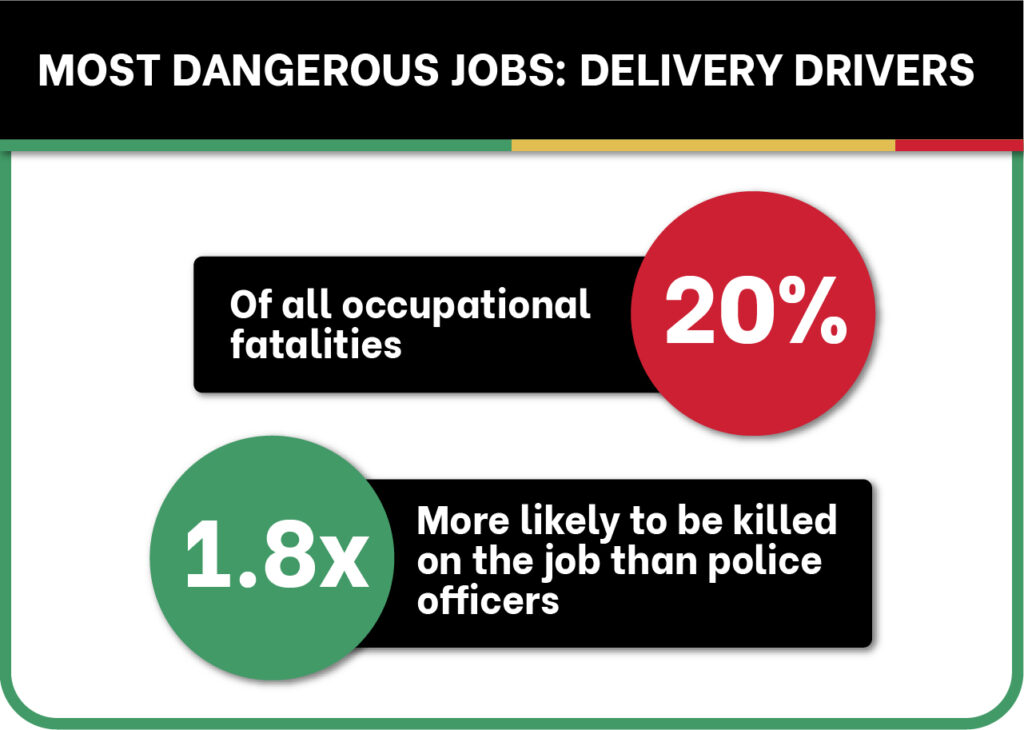
Protecting workers on the go is becoming increasing challenging and difficult. For instance, you may have heard the claim that it’s more dangerous to be a pizza delivery driver than a police officer. According to the U.S. Bureau of Labor Statistics, delivery drivers account for nearly 20% of all occupational fatalities and are 1.8 times more likely to be killed on the job than police officers.
Recent data shows carjackings have increased significantly over the past few years. In cities like Chicago, for example, carjackings have more than doubled in five years. And across the country, vehicle theft is up over 100%. The growing ubiquity of home deliveries is cited as a primary cause.
From road rage incidents and robberies to attacks with unclear motives, grisly stories of violence against delivery drivers have become routine. “We are driving around with targets on our backs,” said Kevin Nelson, an organizer for the advocacy group Chicago Independent Drivers Guild, in a statement.
These startling statistics demonstrate how essential it is for businesses to include field workers in their assessments of crime risk. Any company with workers on-the-go — from delivery drivers to sales representatives, home care and social services workers, and field employees — has an additional layer of security to consider beyond the protections for their brick-and-mortar locations. Wherever your team is located, access to the right data will ensure you’re making the right decisions to keep all members safe.
The New Definition of Workplace Security
Delivery drivers are representative of the changing definition of “workplace security.” For many, the workplace is now wherever they go.
Protecting workers on the go and, indeed, all personnel from harm is every organization’s top priority. To meet this mission, businesses usually focus on erecting protective shields around their workforce. Most of the sophisticated security technology that companies have purchased in the last decade reflects that effort, such as electronic access control, surveillance cameras, and perimeter detection devices. Businesses have spent millions to keep out intruders, and for years this model has helped private businesses meet their goal of protecting workers. 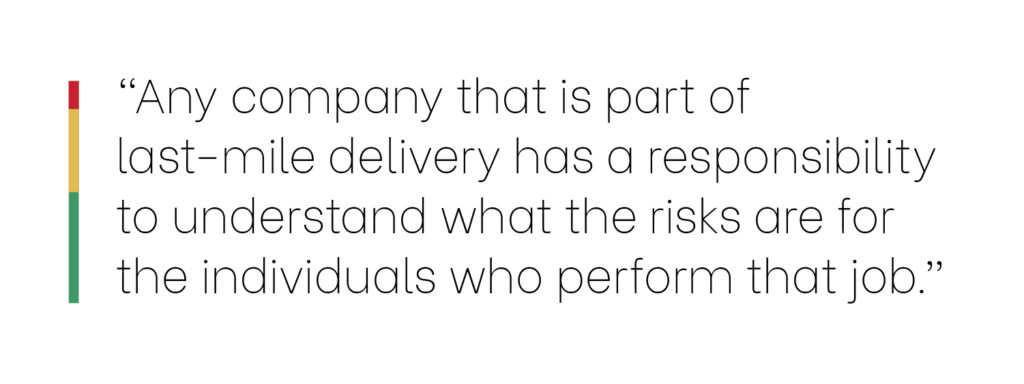
However, this protection model has limitations, as approaching personnel security with a bunker mentality only offers safety when employees stay inside. But today’s employees are less likely than ever to be under a company’s protective shield. Spurred by advancements in smartphone technologies and a convention-breaking pandemic, the mobile workplace has exploded in recent years. Across industries, workers are now on-the-go, traveling to emerging markets or working remotely from home or client sites.
As the nature of the workplace has evolved, so must the strategies to keep workers safe.
Meeting Security Needs of the New ‘Workplace’
Although the challenge is different, the process of protecting mobile workers should start like any security decision: with a risk assessment. For an employer to implement the most appropriate solutions for its workforce, security professionals first need to identify the particular risks facing this population. To start:
- Cultivate data sources to better understand where employees travel for work and where they work from. These may include GPS data, remote login data, travel itineraries, mileage reimbursement reports, and other sources that indicate locations of interest.
- Obtain data that depicts the risk of crime in the areas where employees perform work. Crime risk scores will help determine specific actions to take, such as extending awareness training to a certain department against the crimes that risk scores show they might encounter.
- Communicate with mobile workers (via focus groups, surveys, one-on-one discussions, etc.) to get their feedback on safety risks they perceive while away from the office.
- Make sure the design of the security incident reporting system is sufficient to capture events that occur when workers are away from company property, including all threats. Incident report forms should include a data field for identifying the exact location of the employee at the time of the incident.
Better Alignment of Risk and Protection
Companies that are responsible for last-mile deliveries, or any deliveries, have a responsibility to identify the risks their employees will face on the job. CAP Index’s CRIMECAST Reports and Data can help companies accomplish this. Our CRIMECAST Heat Maps illustrate crime risk levels for every point on the map, providing business and security leaders the ability to visualize crime risk, and in turn make better decisions. Based on the data, companies can develop protocols and take appropriate solutions to shield people and inventory when off-site.
Sometimes, the safest solution for your business is to avoid an unsafe area altogether. After a critical examination of reliable data, companies may decide that the risk of crime in some areas is simply too great, catalyzing new, safer models of operations. Delivery services in areas with the highest crime risk scores might instead create drop-off and pick-up locations where customers can get deliveries through pick-up windows in reinforced, bullet-proof portable containers. It’s just one idea, but businesses must devise solutions that match the risk in areas where they send employees.
The New Security Imperative – Protecting Workers On The Go
Data makes it clear that companies must adopt a broader view of workplace security to include wherever workers go. The new definition of personnel security requires an effective framework for managing security issues and addressing risks when the company has little or no control over the location itself. They must know the risk scores for those locations and develop security controls that workers can take with them.
Get in Touch to Learn More about Delivery Driver Safety.
Find out how CAP Index can help ensure your delivery drivers and field workers are better protected in the field.
Get in Touch Now
Our experts can answer your questions.
Latest Posts

CAP Reports are critical to my risk assessments. They have enabled us to take a more surgical approach to investing in our stores that need it the most.
Brad Reeves
Senior Manager of Asset Protection
Five Below, Inc.

CAP Index is the first tool I turn to when time is of the essence. I can always depend on CAP Index to provide me qualified crime information within a very few minutes that I feel comfortable reviewing with the C-Suite.
Stephen A. Brown, CPP
Director, Corporate Security / Facility Security Officer
Burns & McDonnell

CAP Index data is a vital part of our security decision-making process.
Keith McGlen, CPP, CHPA
Associate Vice President
System Security Services
Memorial Hermann Health System

CRIMECAST® Reports have helped our organization for many years to proactively assess the particular risk for crime surrounding our facilities. The CAP Index® CRIMECSAST Platform is an easy-to-use online service that provides us with the flexibility to share and decentralize crime risk data within our North America business units.
Carlos J. Cortez,
Manager, Global Security Programs,
Kraft Foods, Inc. / Mondelez International

Our property selectors are not discouraged from a site just because it receives a high score. What we do is issue every store – all of them – a security classification. The classification determines how we allocate our security resources to that store.
Claude Verville,
Lowe’s

CAP Index's online platform, CRIMECAST, is great. It is easy to use and quick!
Ken Wieczorek,
Bank of America

In industries where there is high public contact and a customer is coming to our location (such as retail), why would you leave it to chance when planning security when there is an easy, affordable tool? When investing a million dollars on a location, what is this small charge compared to what it may cost you when you get sued?
Jay Beighley,
Nationwide Insurance

CAP Index assessments are a must for anyone engaged in asset protection. The new website is much improved and as important, easy to navigate.
Bruce List,
The Williams Companies

We have been using CAP Index for a few years and include it in our security vulnerability assessments. Highly recommend it.
Dan Yaross
Director, Protective Services
Nationwide Children's Hospital
 FAQs
FAQs News & Media
 Sample CRIMECAST Reports
 Crime Trend and Correlation Reports
 Industry Benchmarks
 What is My Risk Score



Terms Of Use | Privacy Policy | Accessibility
© 2020-2024 CAP Index, Inc. All Rights Reserved.
Site Designed by R2 Creative Group